Chapter 21: every other operator, in one step
Chapter 21's Release is a version number - a major and a minor - that has to print as 1.5 yet sort and compare like any value. One operator is written by hand; the rest come from a single default operator line. The IDE's tools write the record, the constructor's shell and both operators; you type only what no tool can. To play it in the IDE: Help > Lessons > Getting Started with EK9…, or ek9 -ide -lesson book-versions.
What you'll build
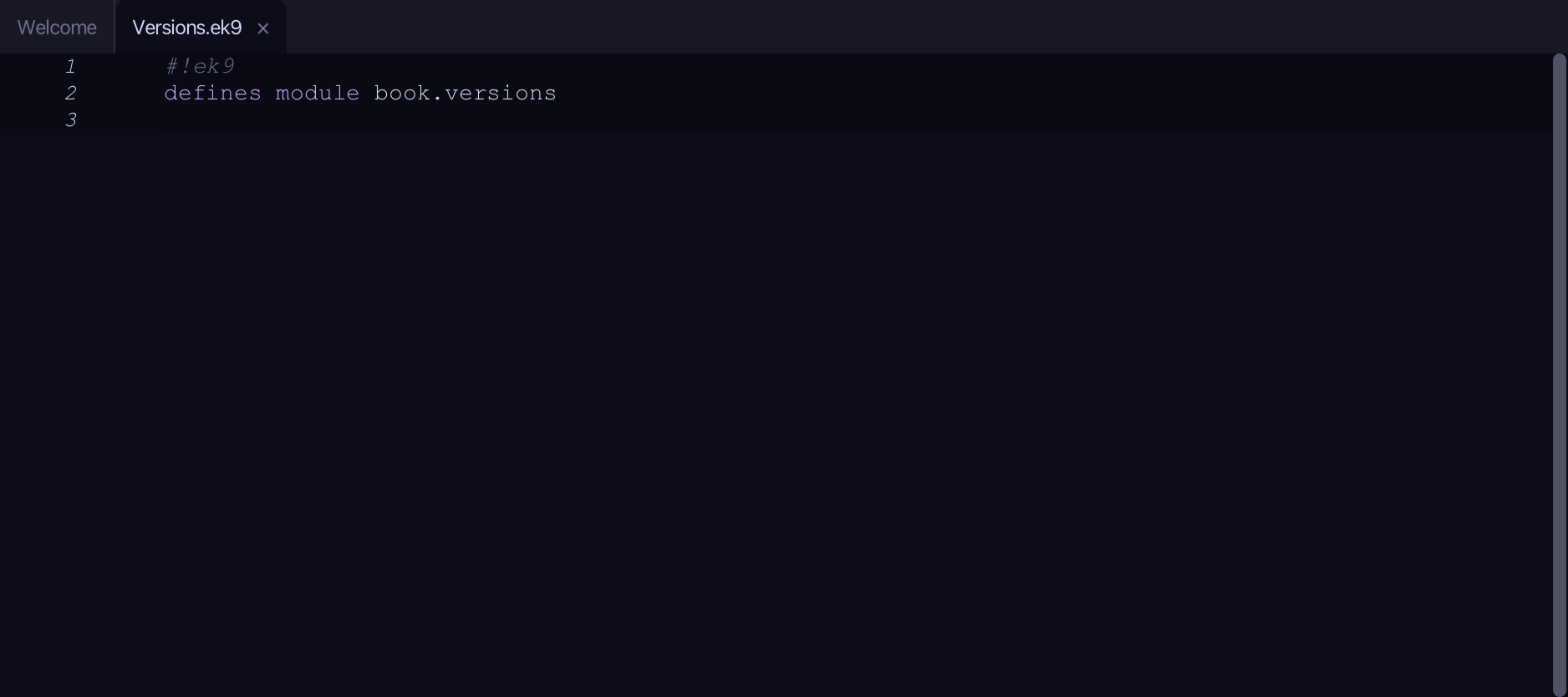
The lesson builds this program from a file holding only its module line - the finished file, as the book prints it.
#!ek9
defines module book.versions

  defines record
    Release
      major as Integer: Integer()
      minor as Integer: Integer()

      Release() as pure
        ->
          initialMajor as Integer
          initialMinor as Integer

        major :=? Integer(initialMajor)
        minor :=? Integer(initialMinor)

      //Written by hand, because "1.5" is our own idea of how a Release reads
      operator $ as pure
        <- rtn as String: `${major}.${minor}`

      //And the compiler fills in every other operator it can work out for itself
      default operator

  defines program
    Show()
      stdout <- Stdout()

      versions <- List() of Release
      versions += Release(2, 0)
      versions += Release(1, 5)
      versions += Release(2, 3)

      sorted <- cat versions | sort | collect as List of Release
      for v in sorted
        stdout.println(`sorted: ${v}`)

      a <- Release(1, 5)
      b <- Release(2, 0)
      stdout.println(`a < b?   ${a < b}`)
      stdout.println(`a > b?   ${a > b}`)
      stdout.println(`as text: ${a}`)
      stdout.println(`as JSON: ${$$a}`)
Step 1: A record
Choose Code > New Construct > Record…
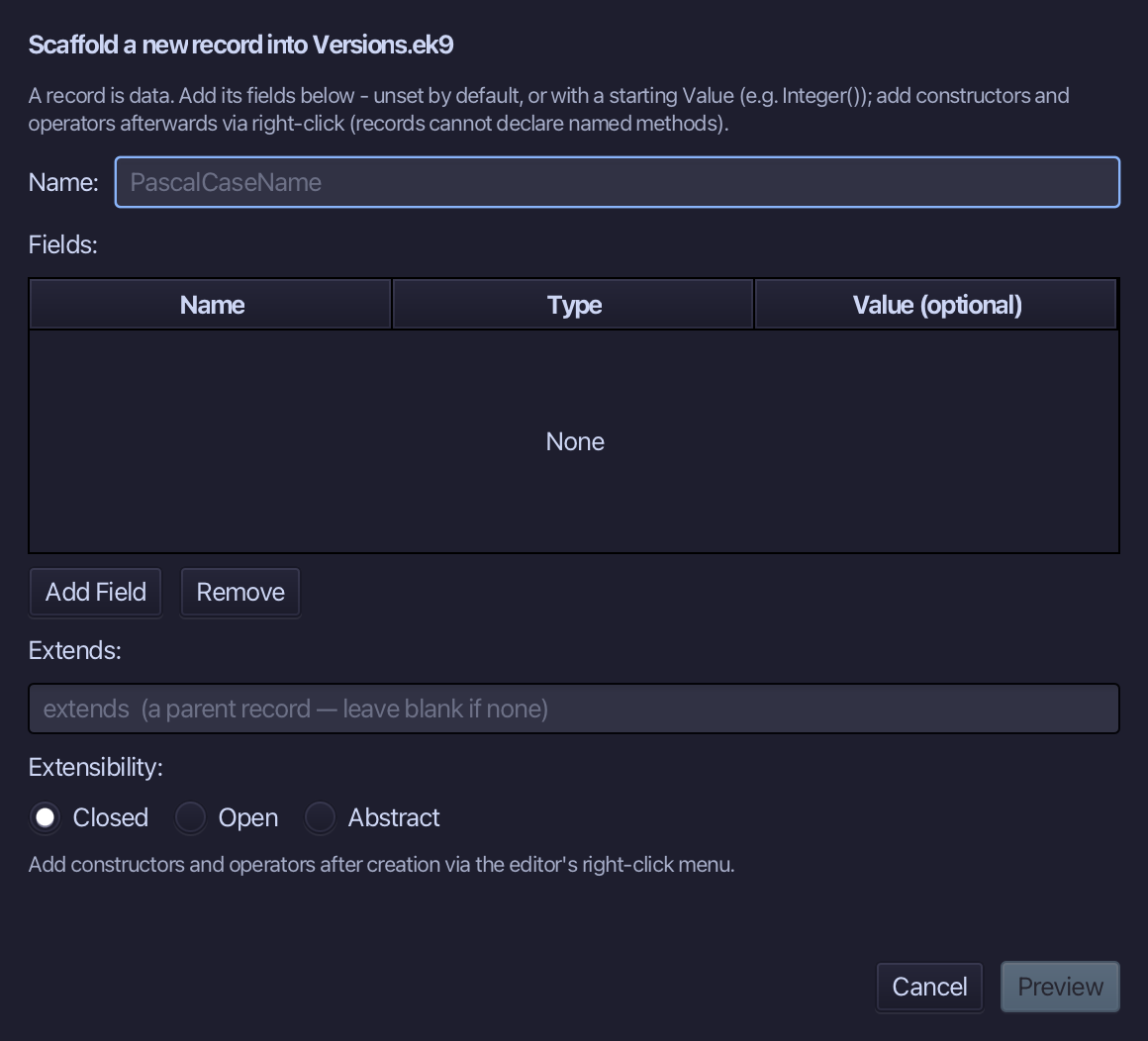
Release is the record's name. Add major and minor, both Integer, each starting at Integer(). Choose Preview.
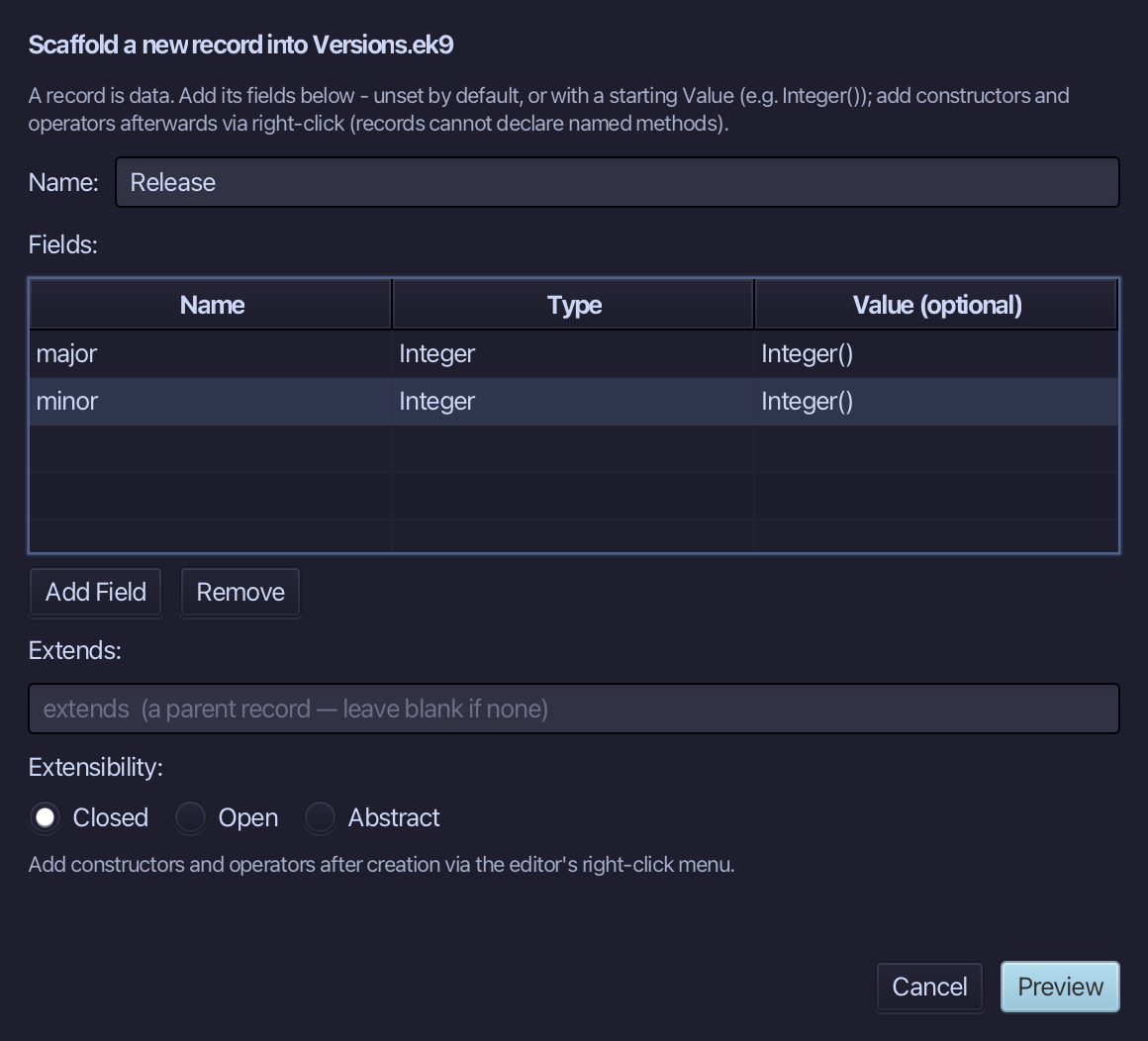
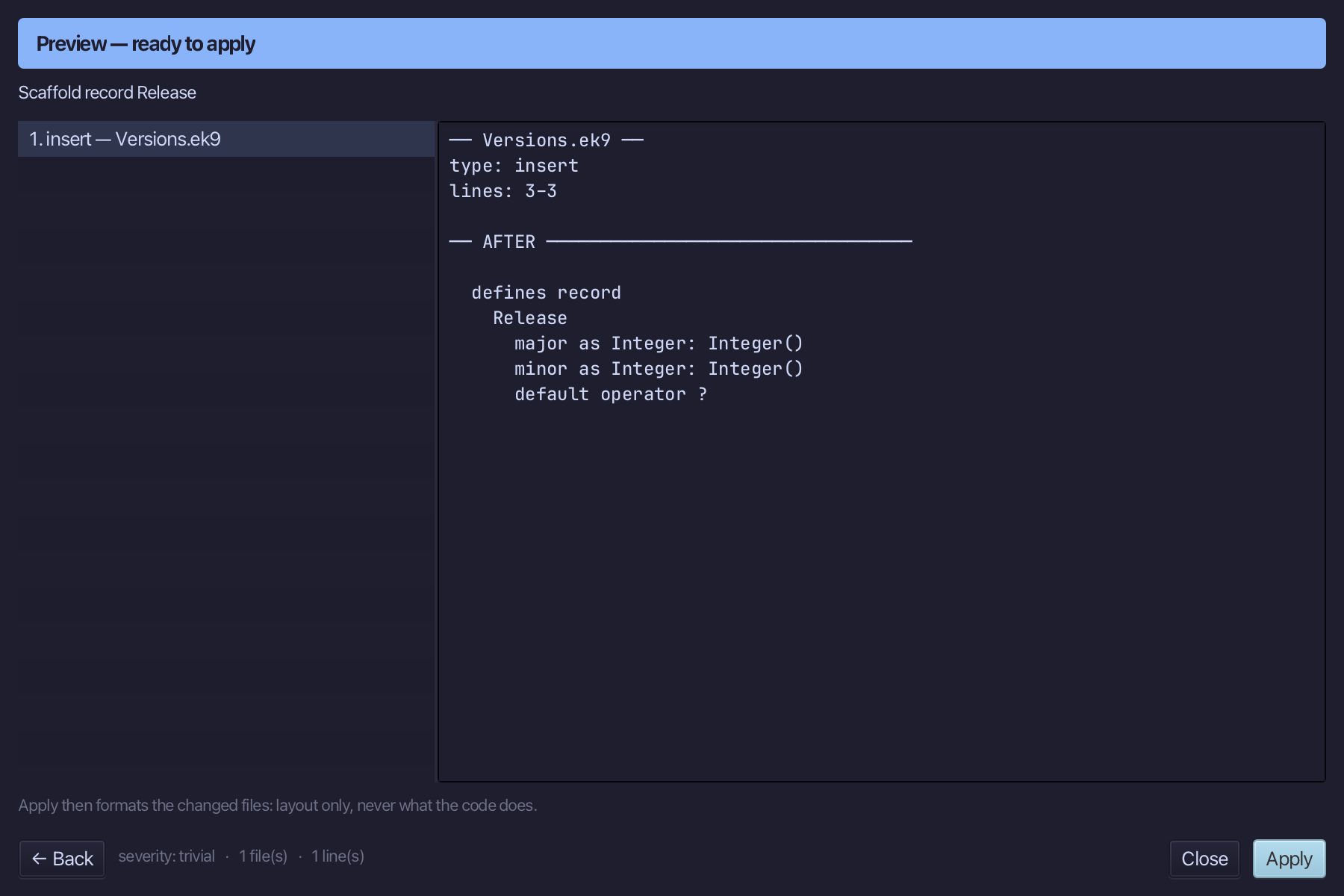
The preview shows Release with both fields - and default operator ? with them. Choose Apply.
Step 2: Its constructor
Right-click the Release line and choose Add Constructor > From All Fields (pure).
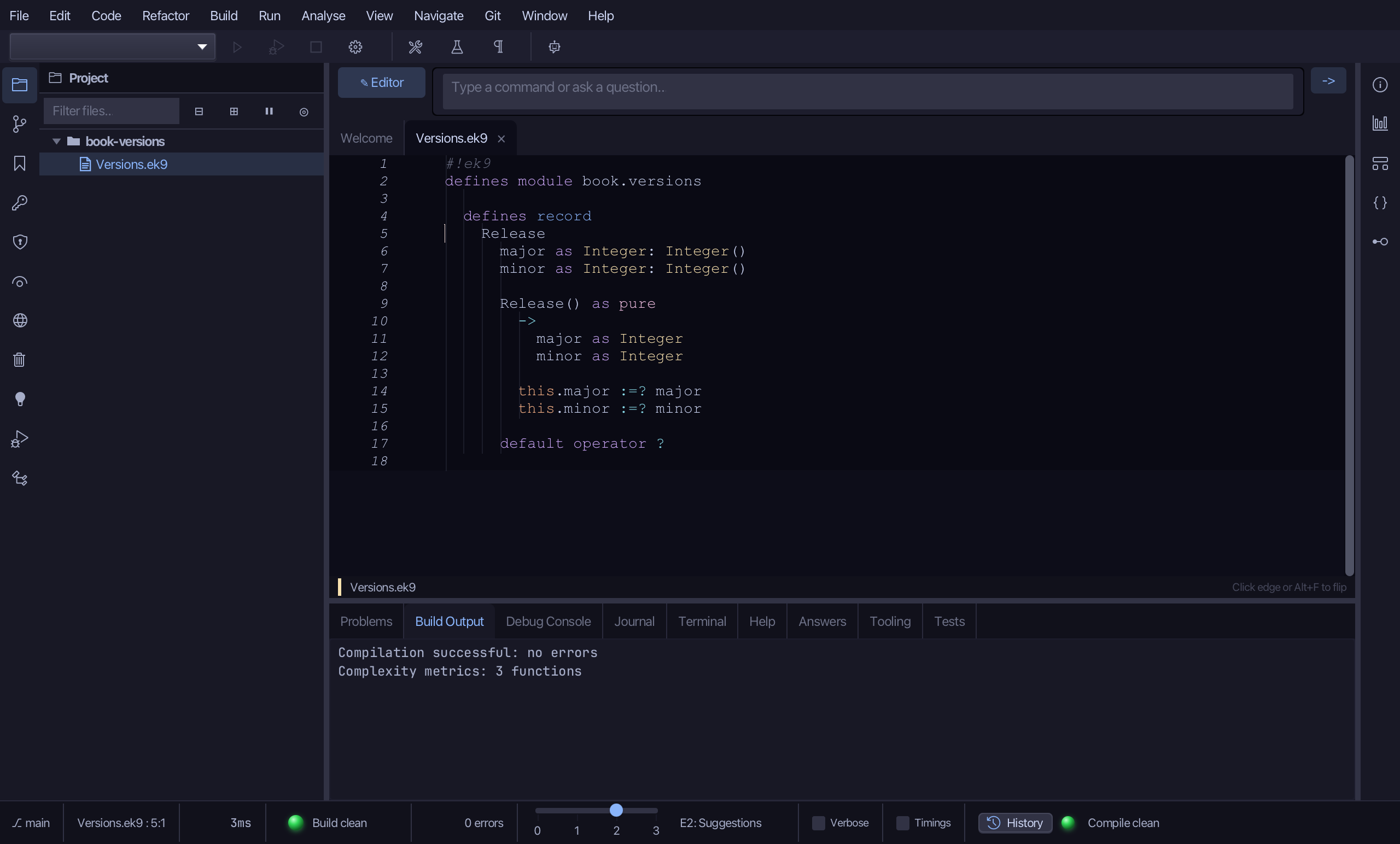
Select the stub, from Release() as pure down to its last assignment, and type the constructor the book shows: initialMajor and initialMinor in, major and minor set with :=?. Saves when typed.
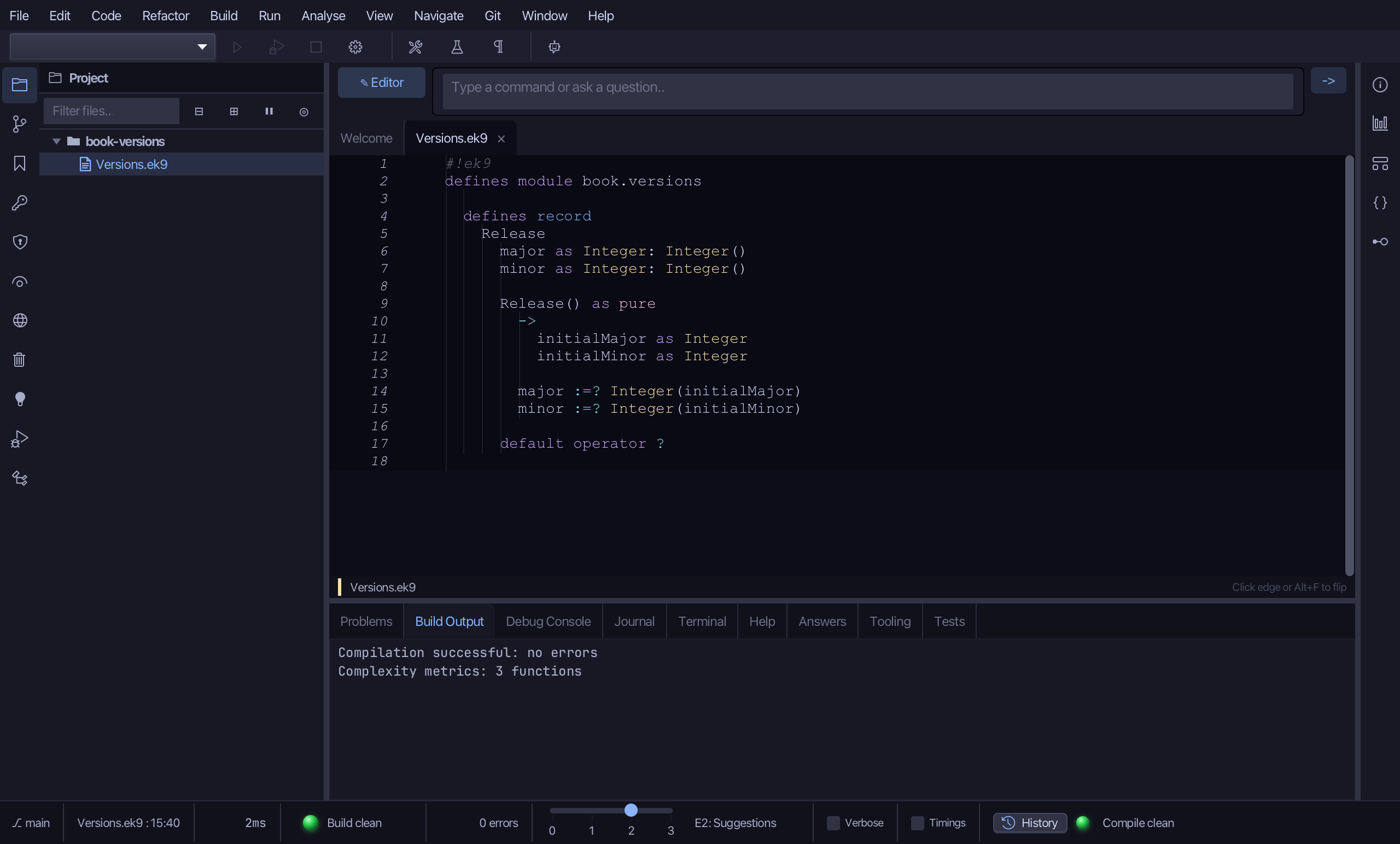
Step 3: One operator by hand
Right-click the Release line and choose Add Operator > $ (string) > skeleton.
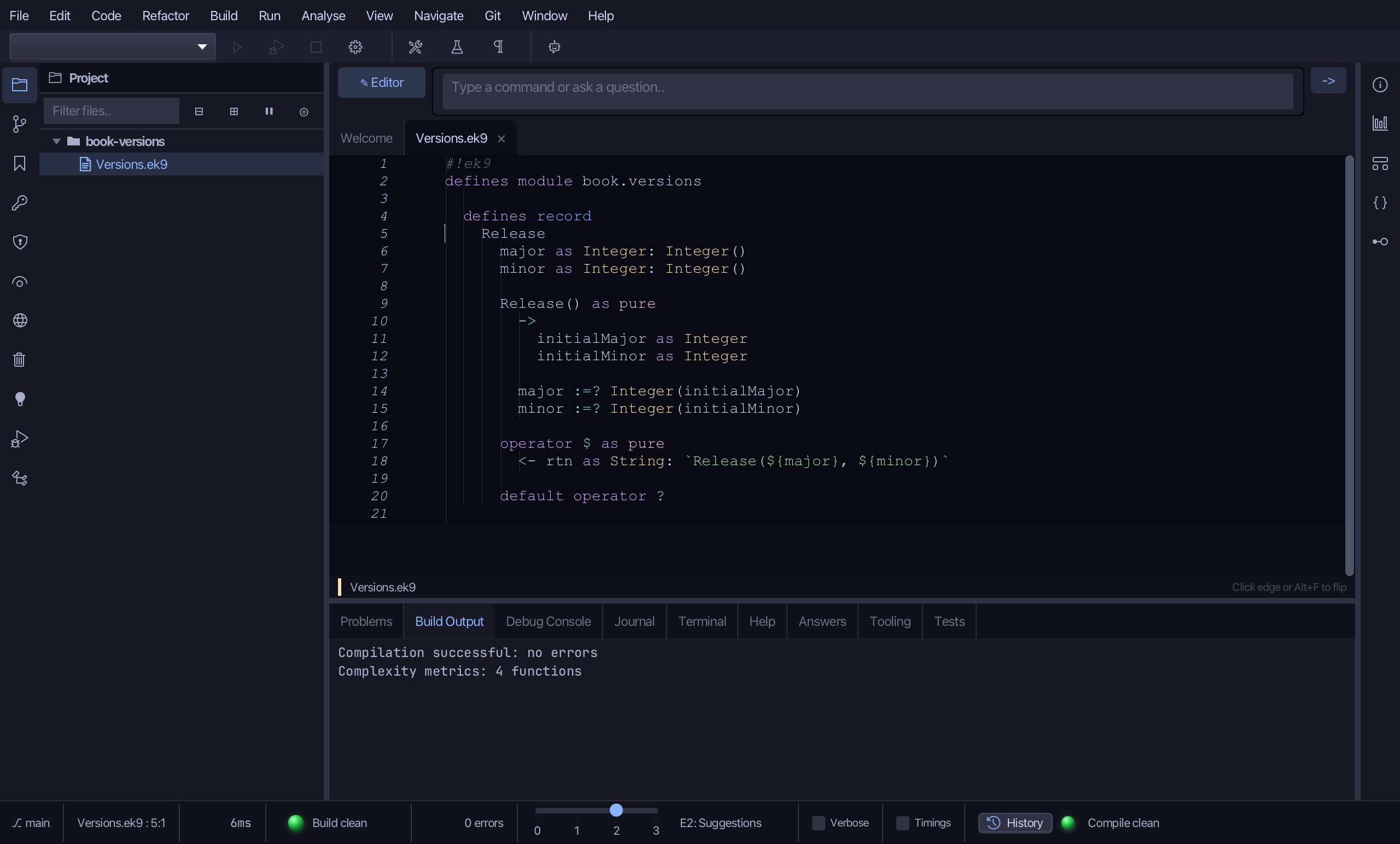
Select the stub line and type $'s own text form - major, a dot, minor. Saves when typed.
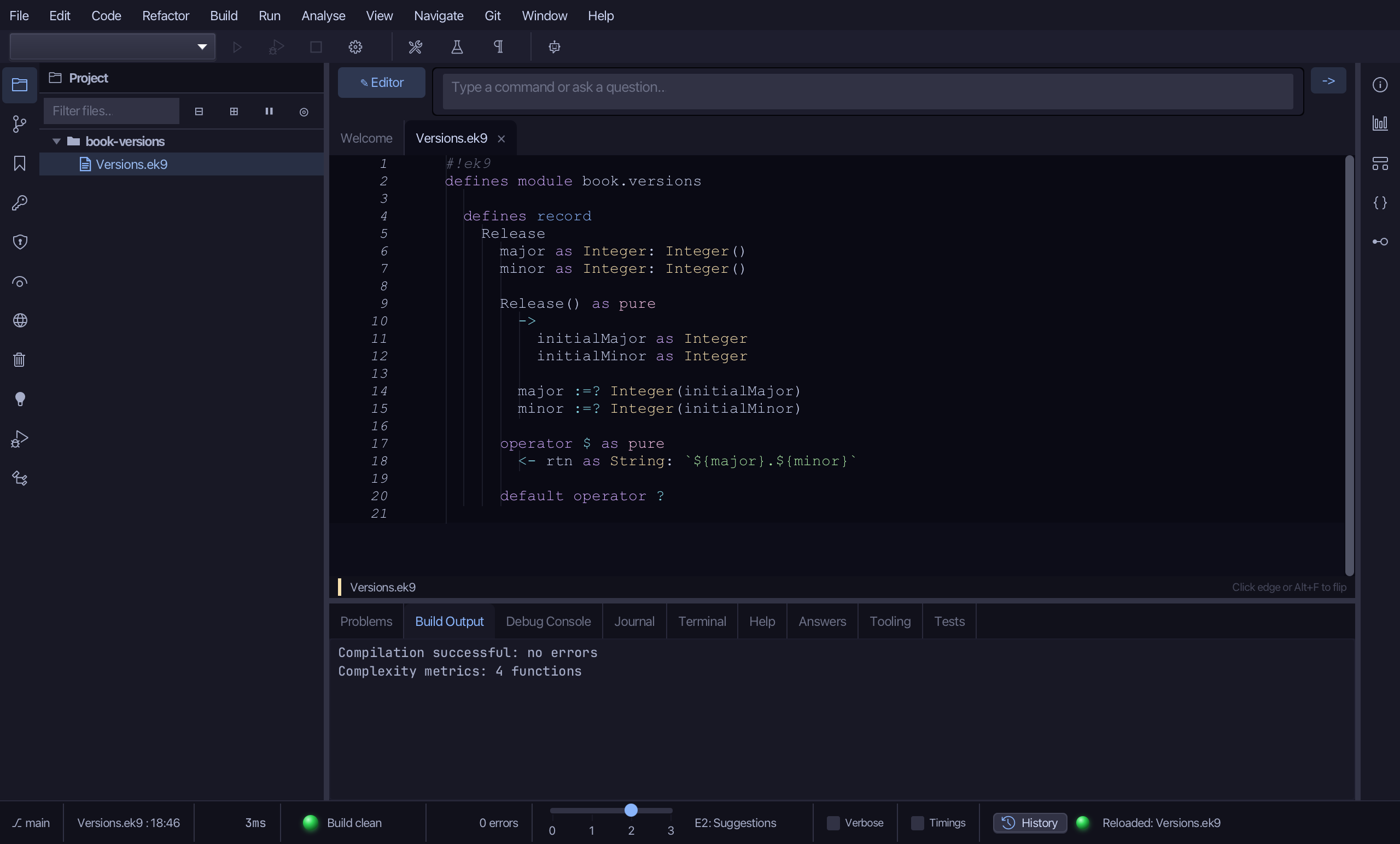
Select the operator $ line and, above it, type the comment that says why it is written by hand. Saves when typed.
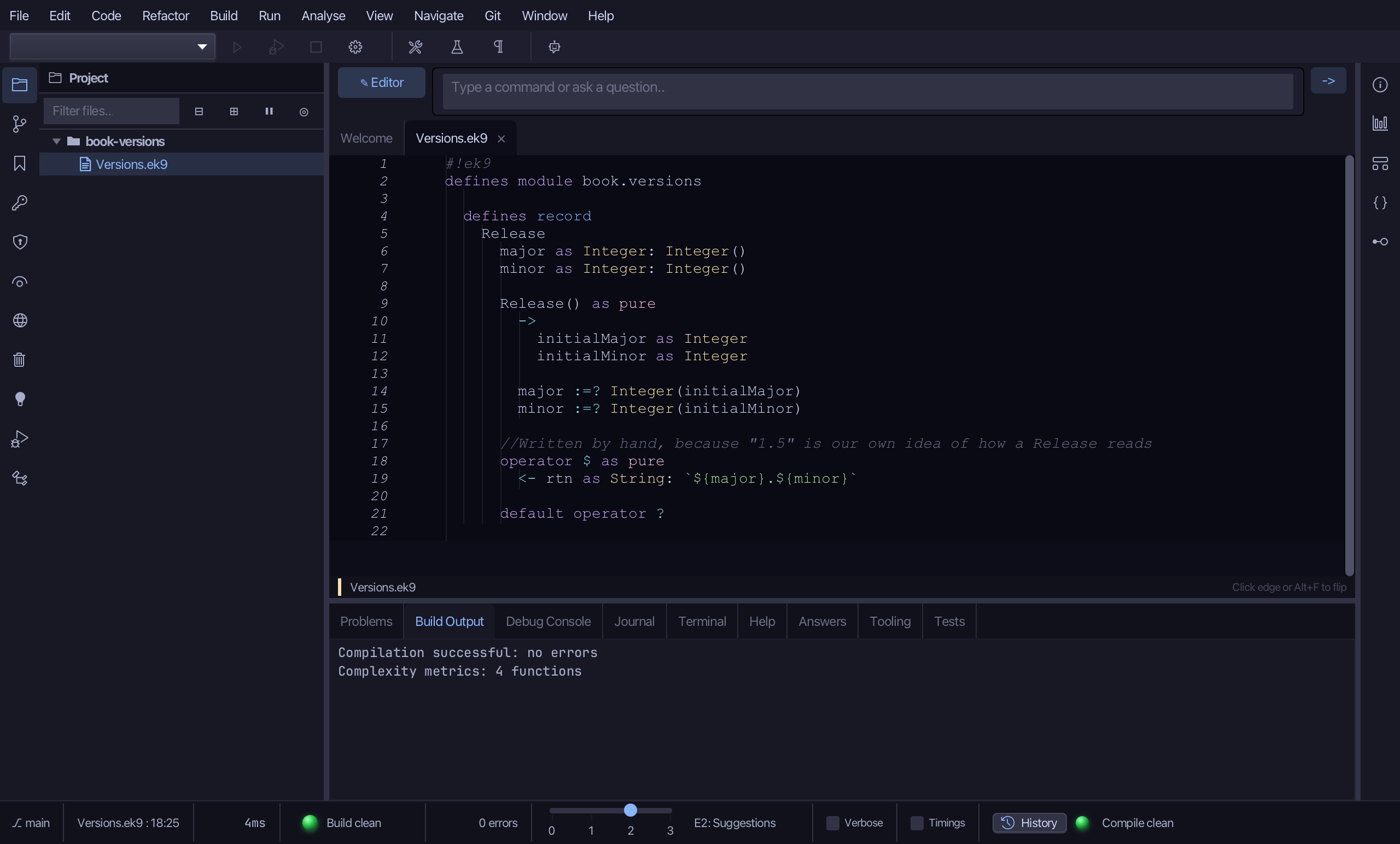
Step 4: Every other operator, in one step
Right-click the Release line and choose Add Operator > default operator (all missing) - one bare 'default operator' line, and the compiler works out == <=> < <= > >= <> $$ and the rest from the two fields.
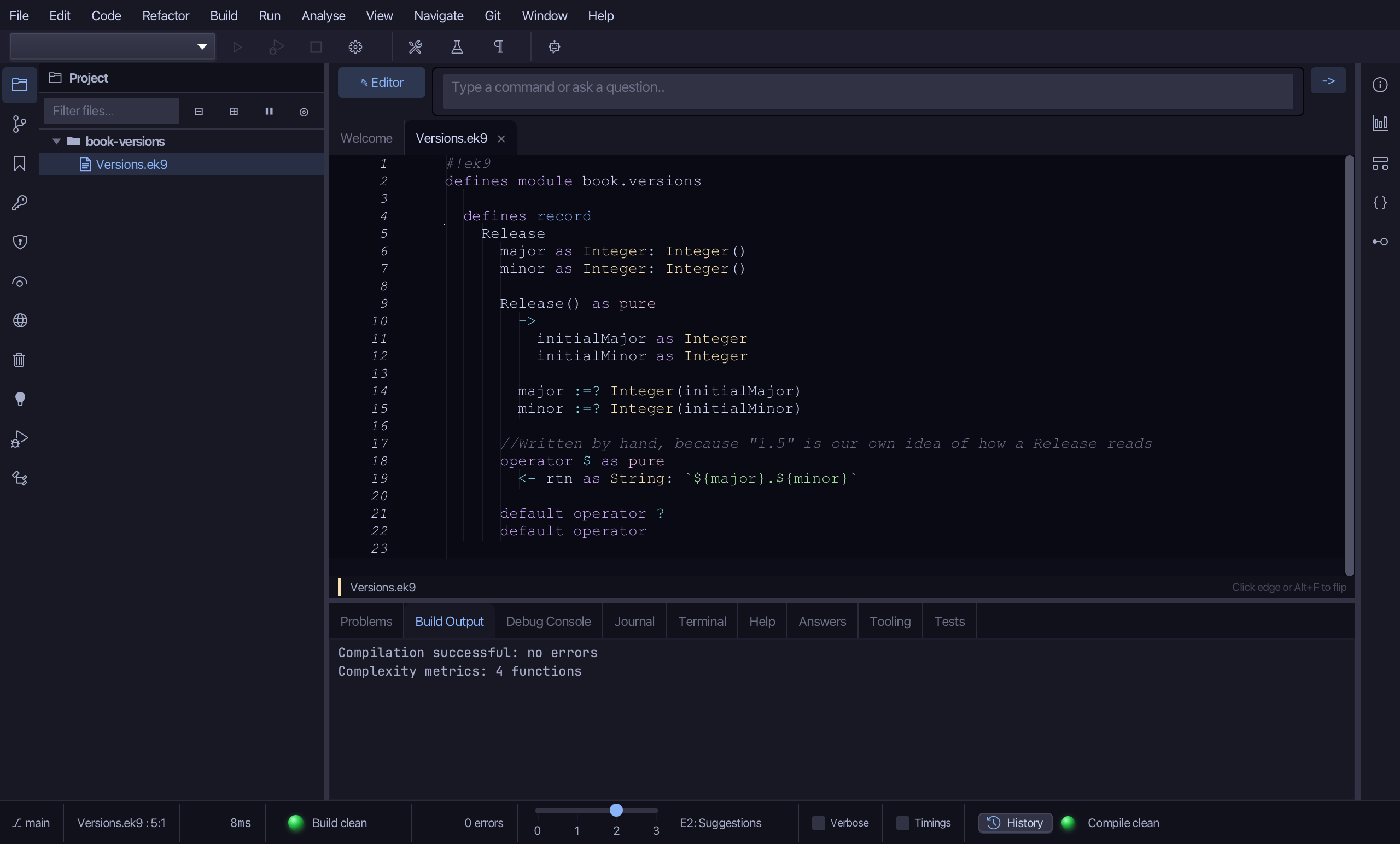
The bare line already includes the ? operator, so delete the default operator ? line above it - the one the record was created with. Saves when typed.
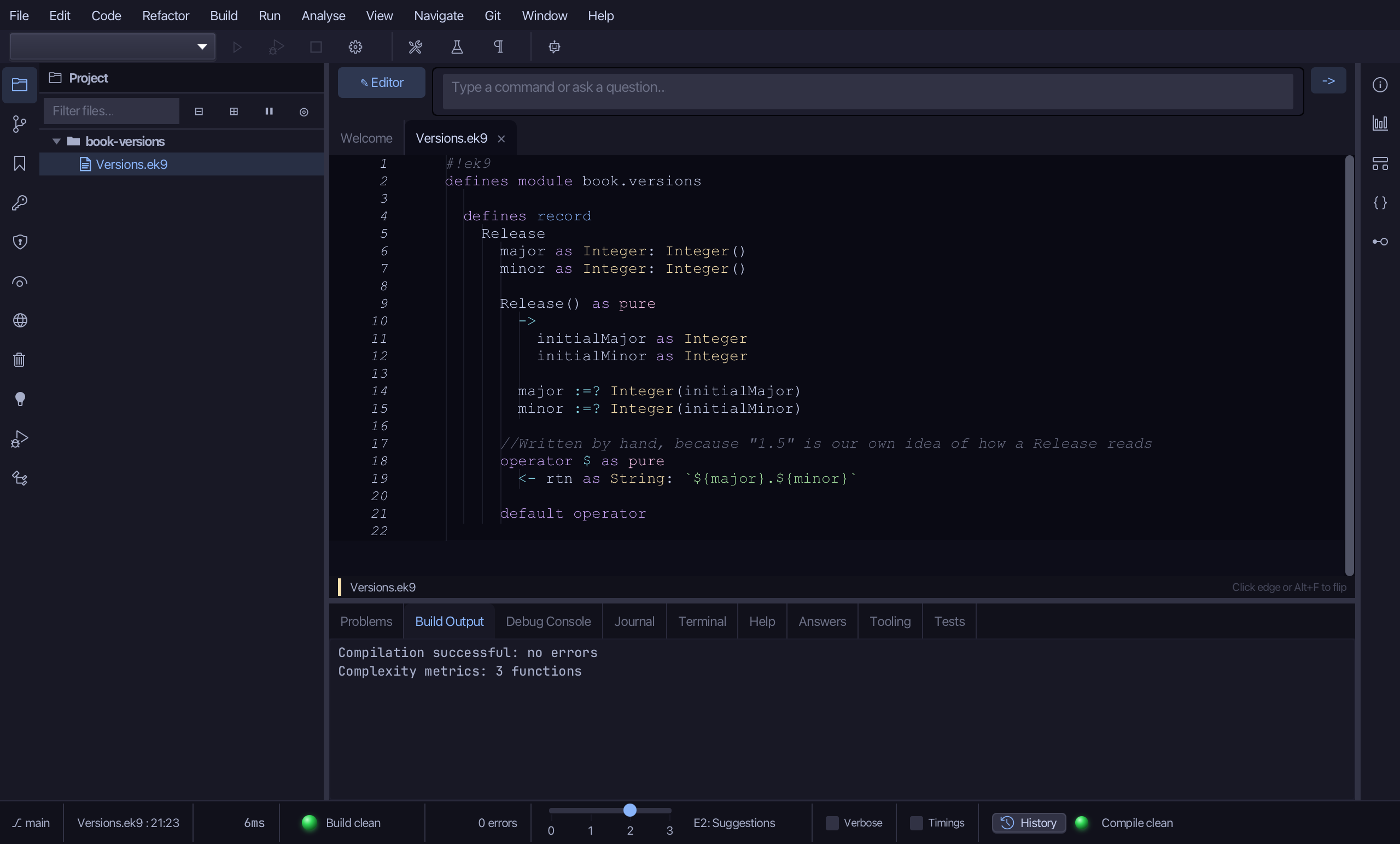
Select the default operator line and, above it, type the comment that says what it does. Saves when typed.
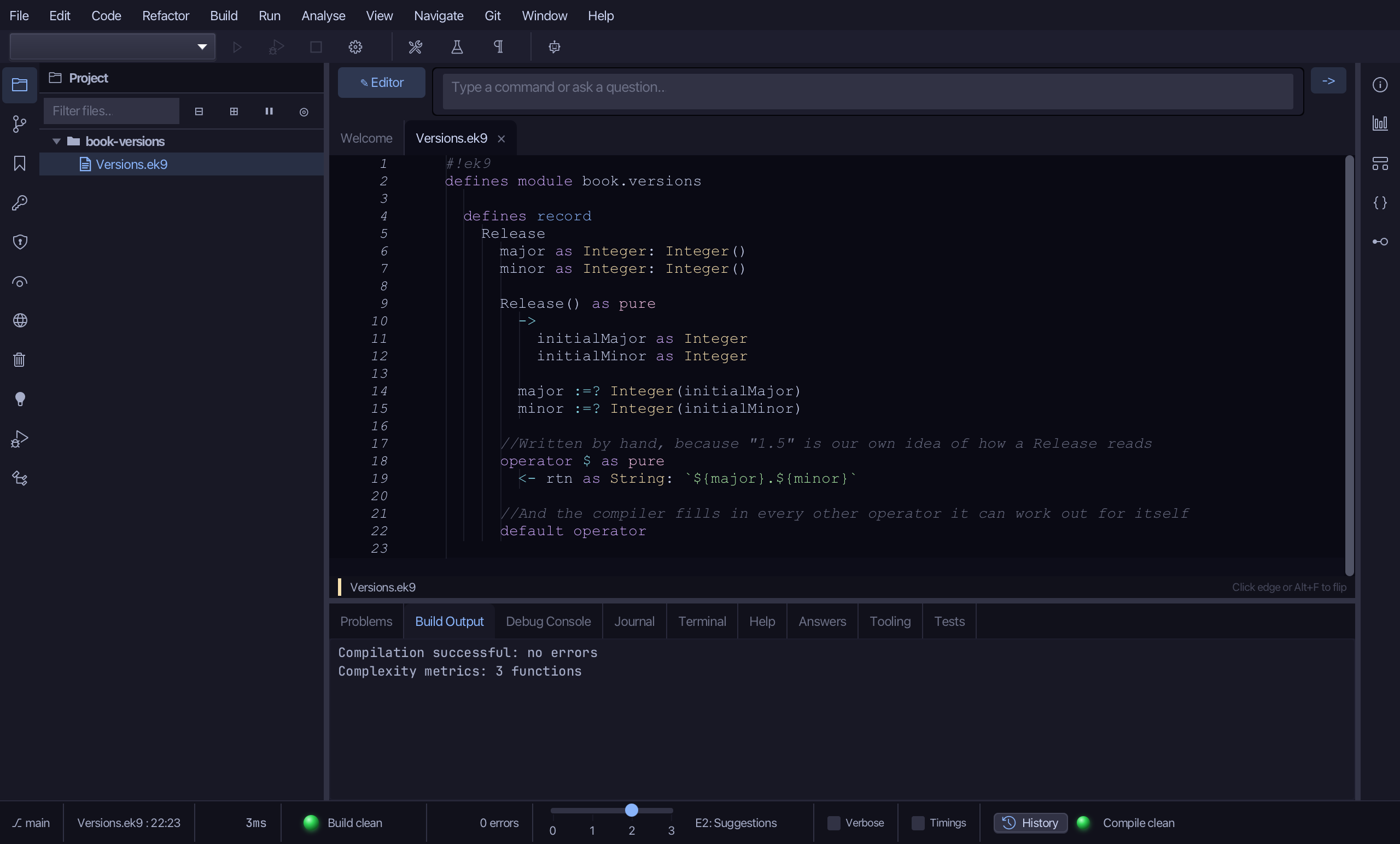
Step 5: The program
Choose Code > New Construct > Program…
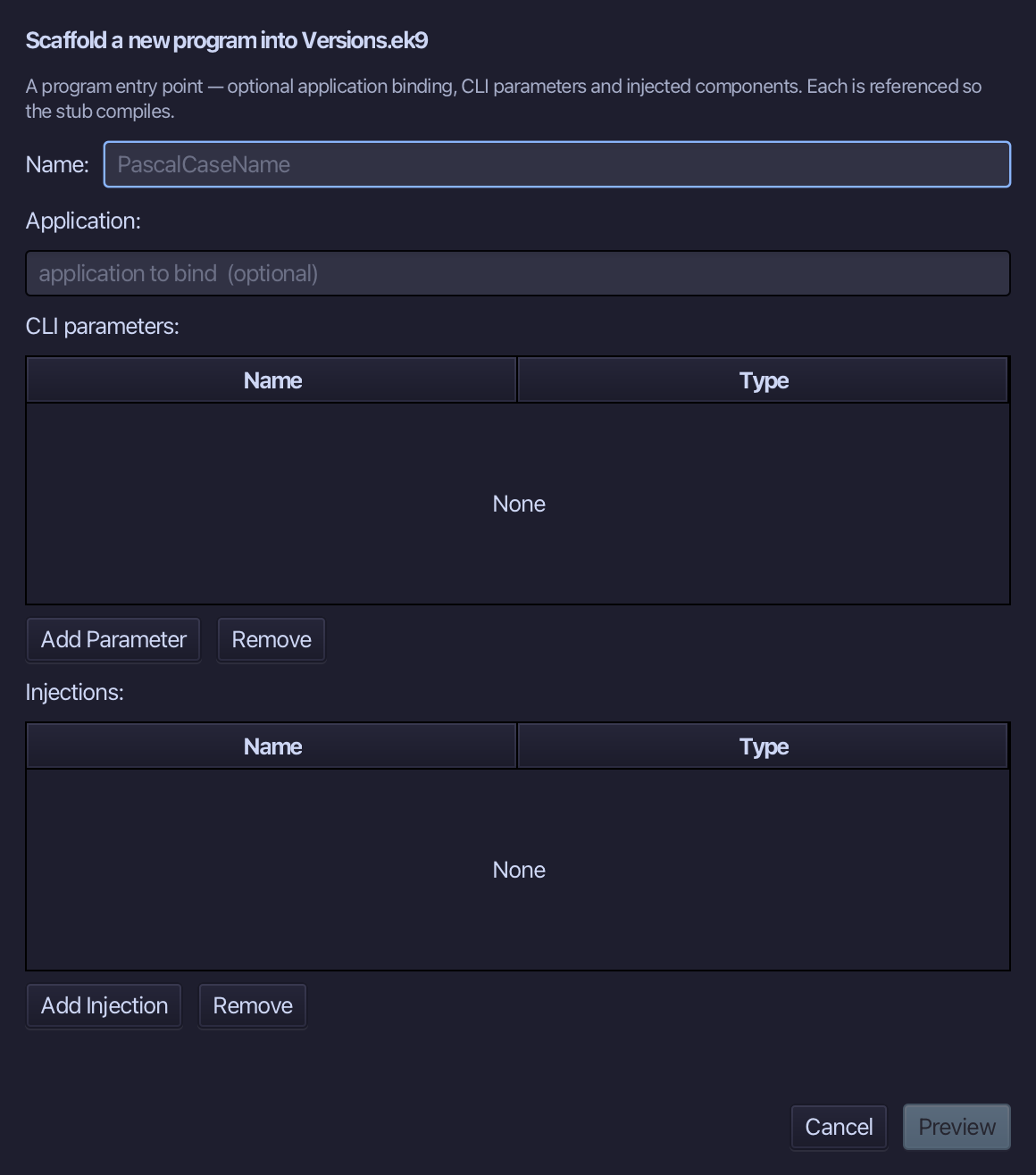
Show is the program's name. Type Show and choose Preview.
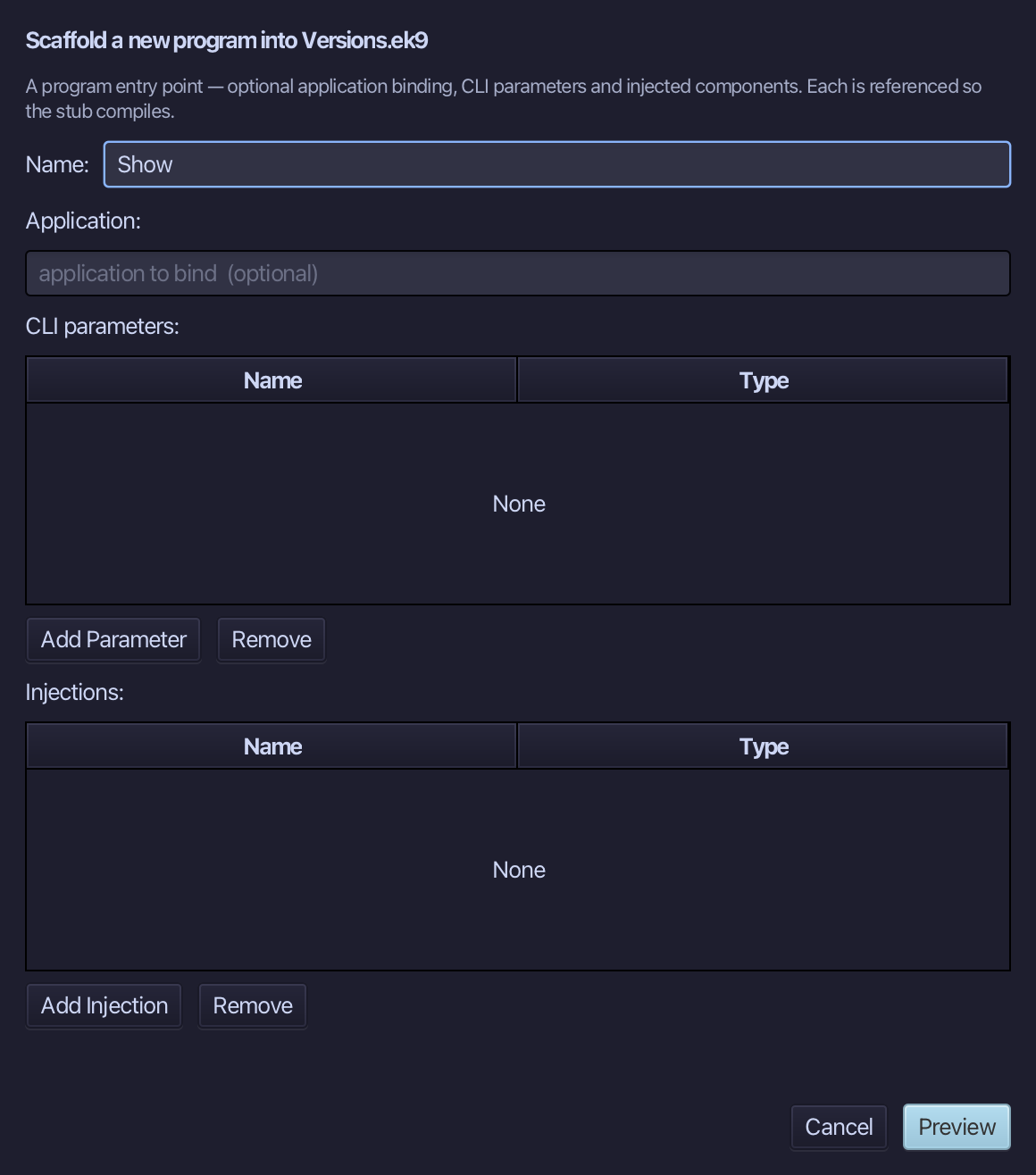
The preview shows Show about to be written. Choose Apply.
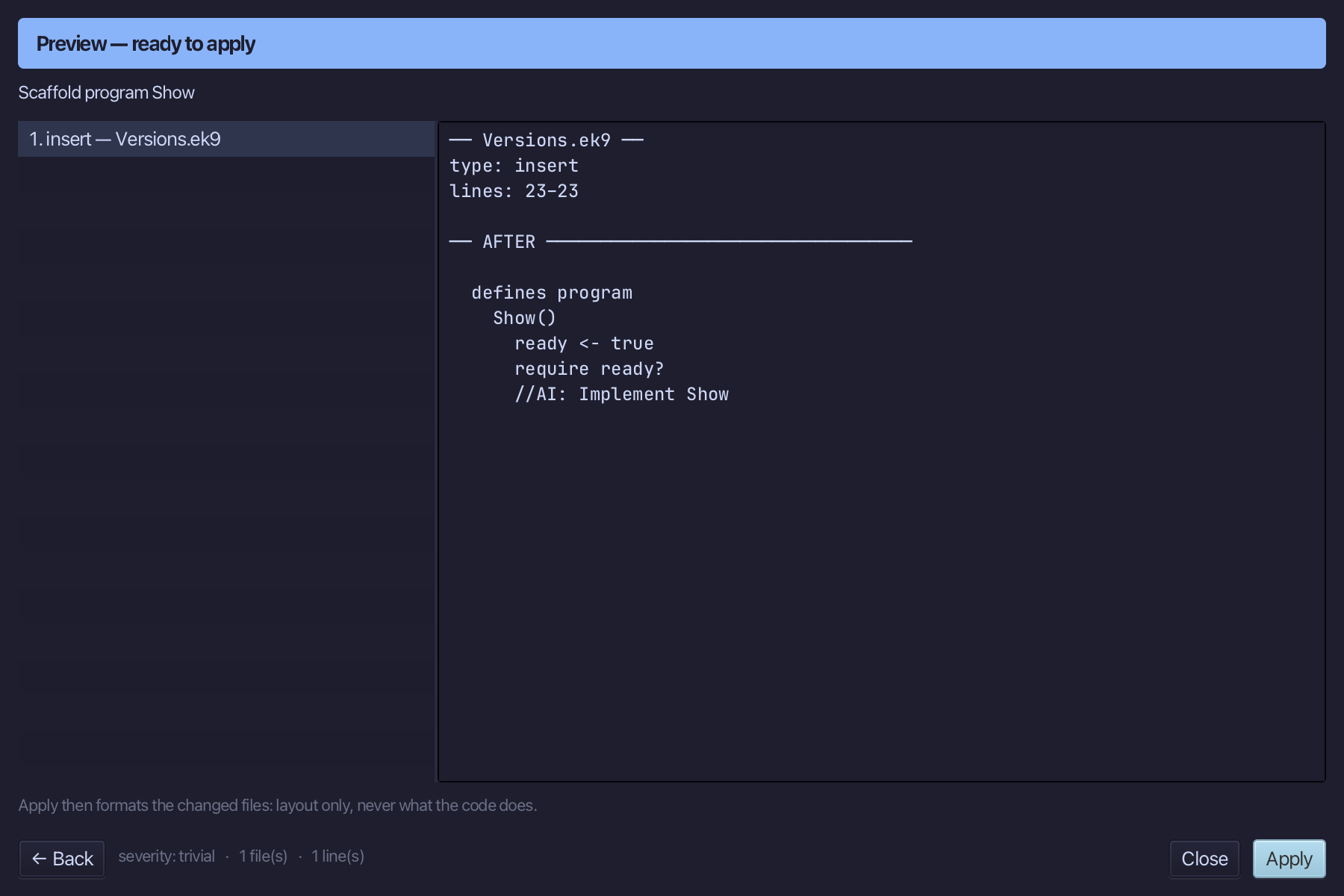
Select the stub, from ready <- true down to its //AI line, and type Show's body: three releases sorted and printed, then a comparison, the text form and the JSON form. Saves when typed.
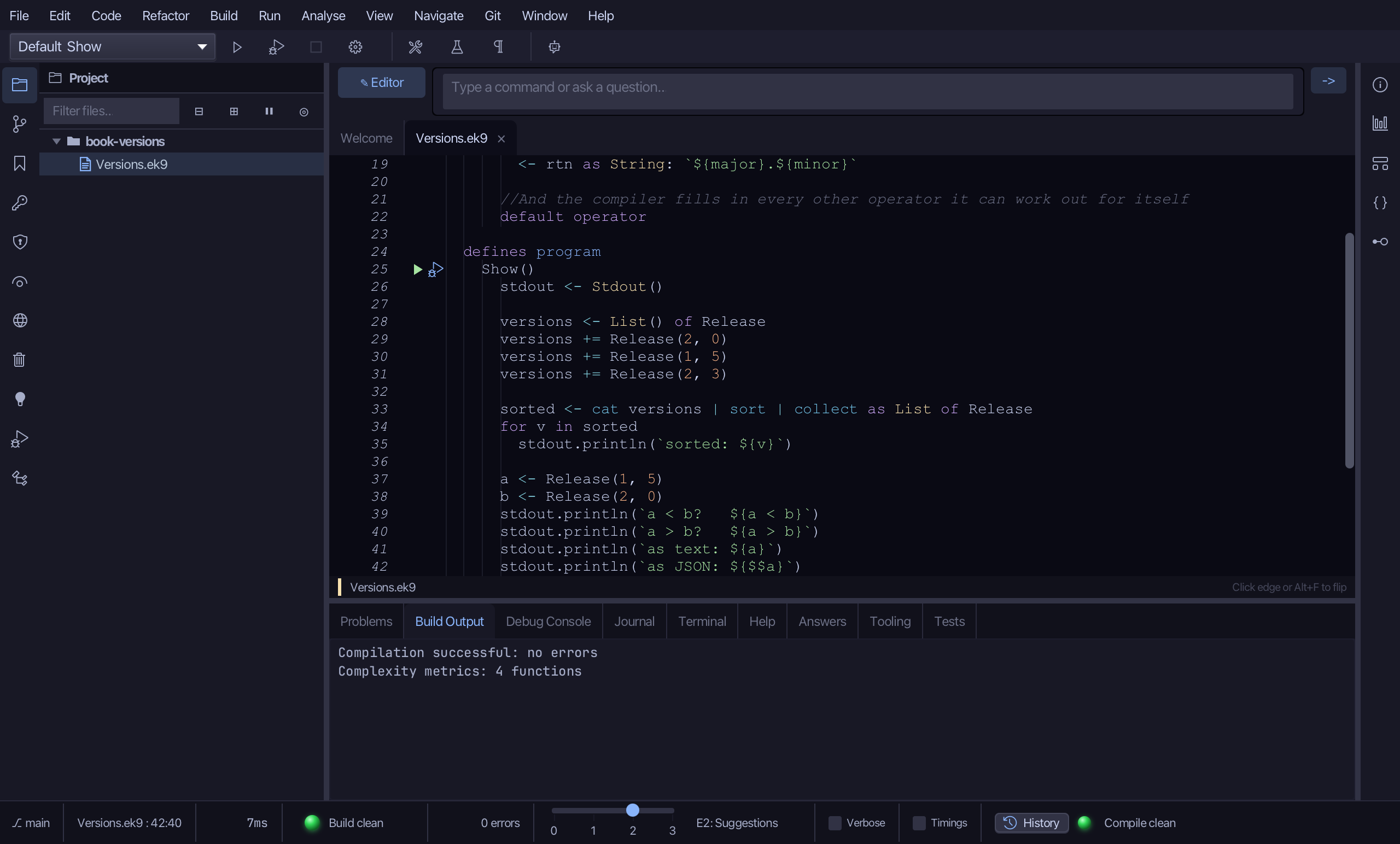
Step 6: Run it
Choose Run > Run Program…
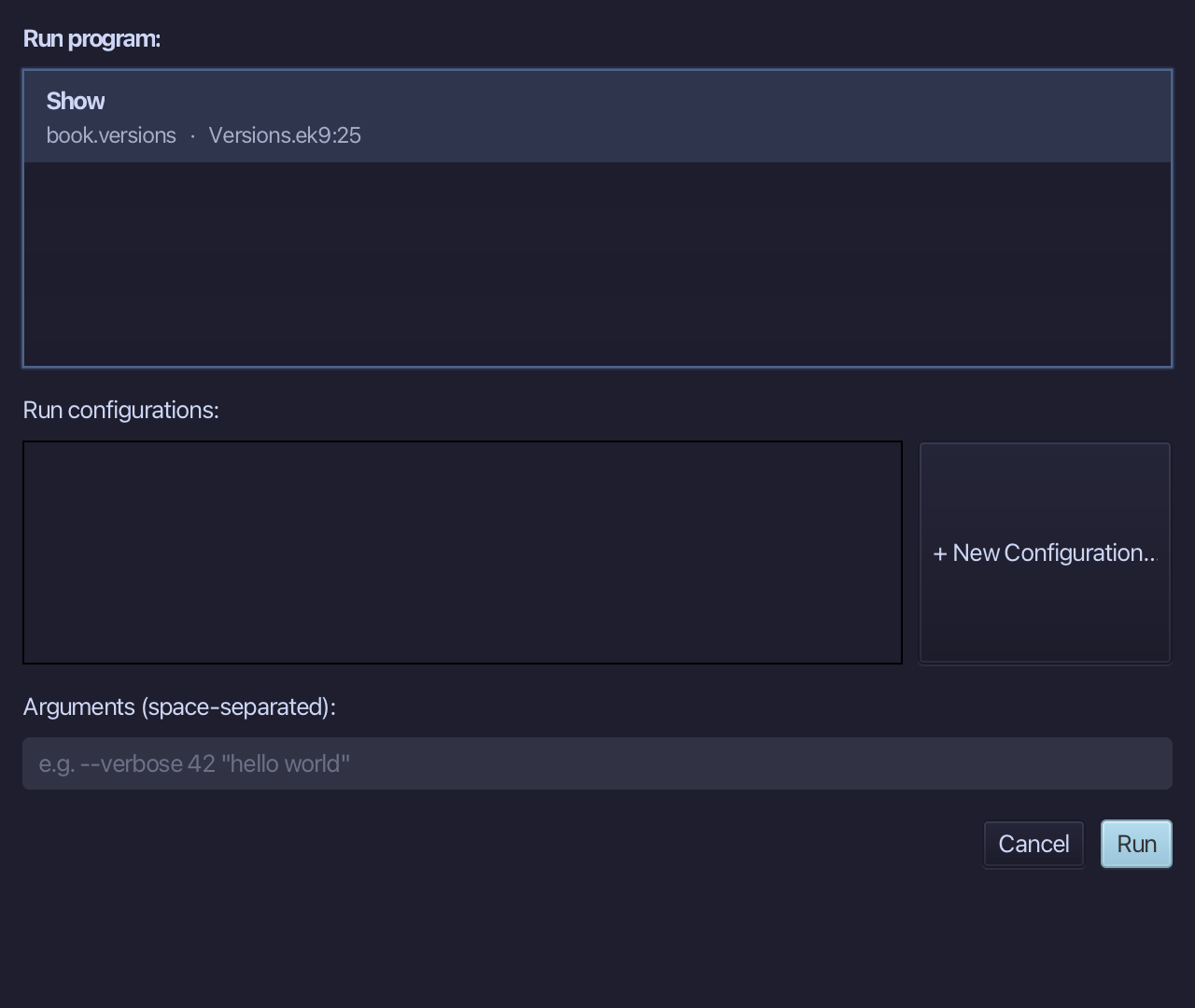
The project's only program is already chosen. Choose Run.
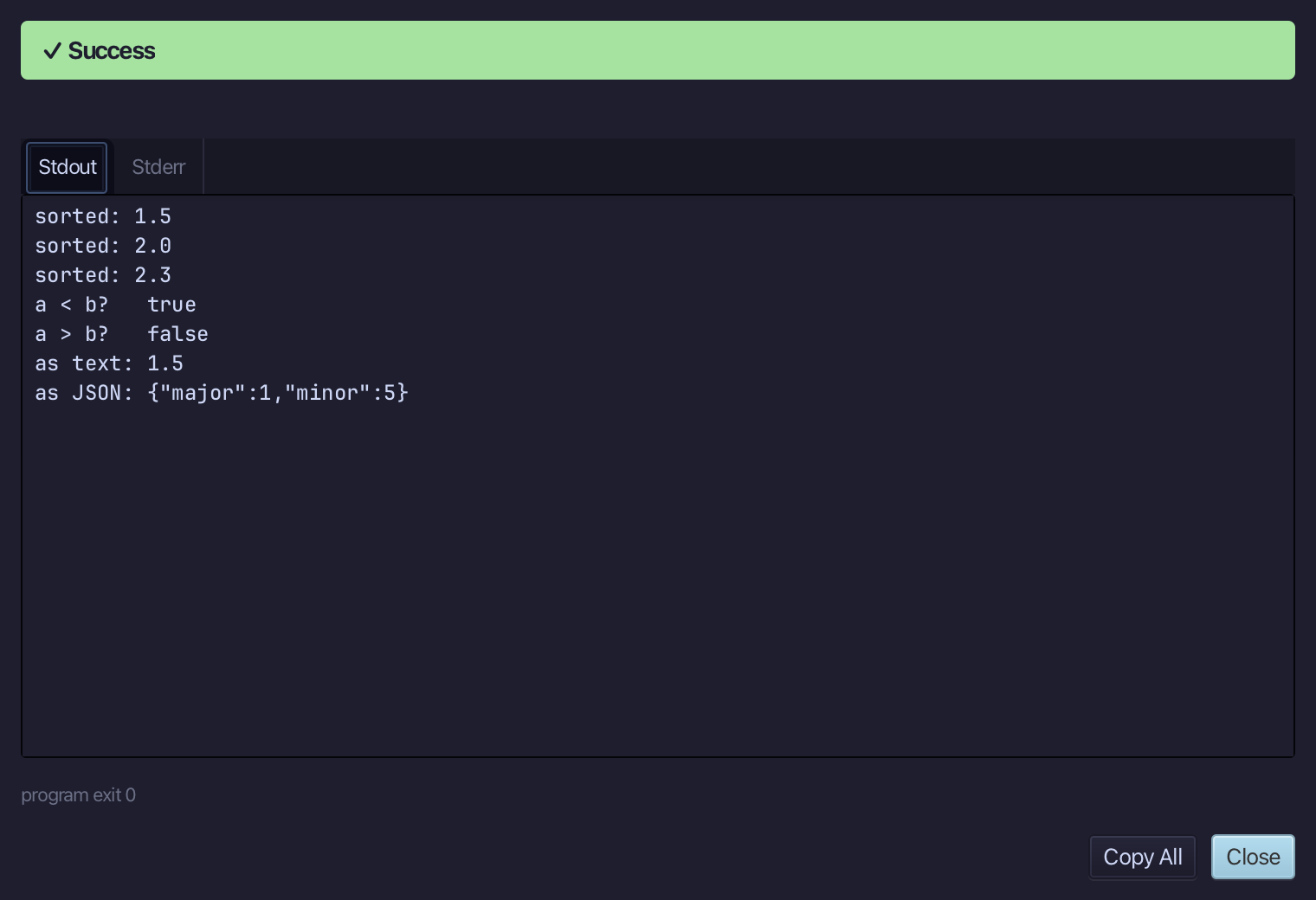
sorted: 1.5, 2.0, 2.3 - a < b? true, a > b? false, as text 1.5, and as JSON the record's own two fields: every one worked out from a single default operator. Choose Close.
The result
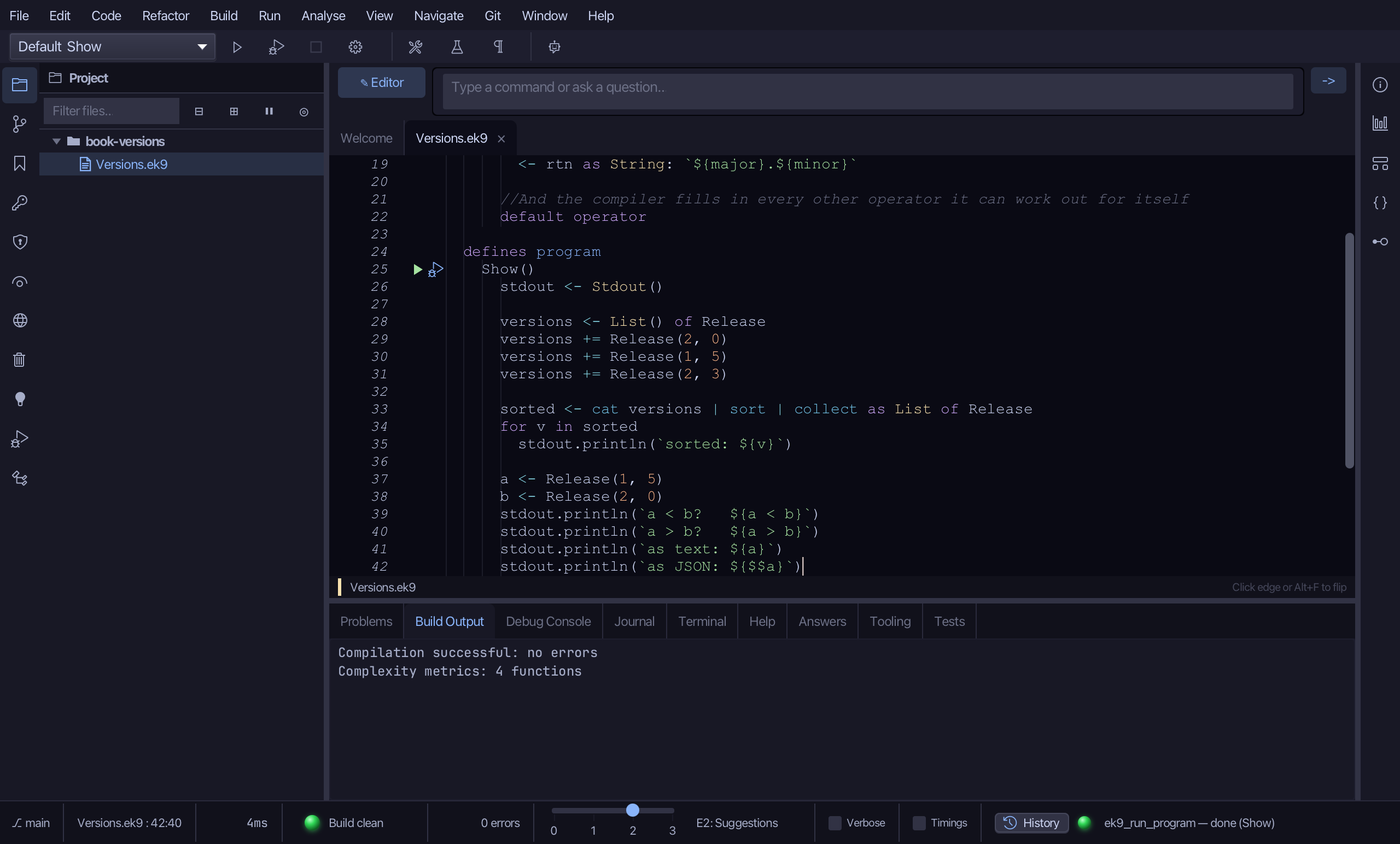
Versions.ek9 now reads exactly as chapter 21 of Getting Started with EK9 shows it: a Release that prints as 1.5 because its $ is written by hand, and sorts, compares and turns to JSON because one bare 'default operator' line lets the compiler work the rest out from its two fields. Add Operator ▸ default operator (all missing) wrote that line; expand-default-operator shows how to turn any one of them back into an explicit body. AI assistants use ek9_new_construct, ek9_add_constructor, ek9_add_operator (with no operator named, for the bare line) and ek9_add_program.
Where this lesson comes from
- For AI assistants - the MCP tool
ek9_new_construct,ek9_add_constructor,ek9_add_operator,ek9_add_program.
In the EK9 reference: EK9 Operators, Records in EK9